
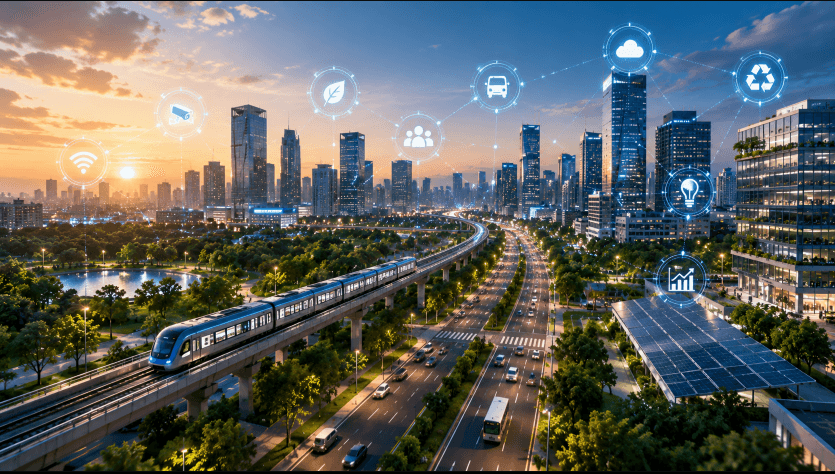
Smart Cities
One of the biggest question today for the Urban Planners and City Administrations are how to manage the cities in wake of growing urbanization.
Published May 4, 2026
One of the biggest question today for the Urban Planners and City Administrations are how to manage the cities in wake of growing urbanization. It is estimated that by 2030 70% of the world population would be living in urban centers. Imagine the burden on urban resources and utilities with increased population when they are hardly being able to cope with the existing requirements of electricity, water, transportation, security and clean air.
One of the biggest question today for the Urban Planners and City Administrations are how to manage
the cities in wake of growing urbanization. It is estimated that by 2030 70% of the world population
would be living in urban centers. Imagine the burden on urban resources and utilities with increased
population when they are hardly being able to cope with the existing requirements of electricity, water,
transportation, security and clean air.
Energy Management System for Public Transport – A case of Karachi’s Bus Rapid Transit
Linked Things recently installed energy management system at every bus station of the Karachi’s Bus
Rapid Transit System (BRT). The BRT covers 25km of important route that connects the north most part
of the city with the port in the south. Energy management system is to monitor the consumption in real
time, prepare trend analysis, generate alerts and provide comparison from one station to another. This
is an important tool to identify the leakages and wastages of energy utilization at a public sector service.
It is estimated that upto 25% of the electricity can be saved by using EMS.
The data is being received live from all 23 functional stations of the BRT and collected at the OCC set up
to monitor the operations.
Air Quality Monitoring in Metropolitan Areas – A case of Karachi, Lahore and Peshawar
Linked Things decided to venture into the air quality monitoring as the major cities are struggling to
maintain health levels of air quality. The units deployed by Linked Things are capable of monitoring
PM2.5, CO, SO2, NO2 and O3 pollutants along with temperature, pressure and humidity levels. The data
is recorded at every second so that environmentalists and researchers can conduct studies on the
causes of air quality based on spatial and temporal data and determine local nuances of the causes of
pollution. The units installed are simple to install and self sufficient from power perspective as they run
on solar energy.
The data is being received from over 50 units installed in Karachi, Lahore, Islamabad and Peshawar in
realtime, stored on a cloud and shared with the public in real time. We have developed historical trends
and predictions there as well.